
Programmatic SEO agency comparison
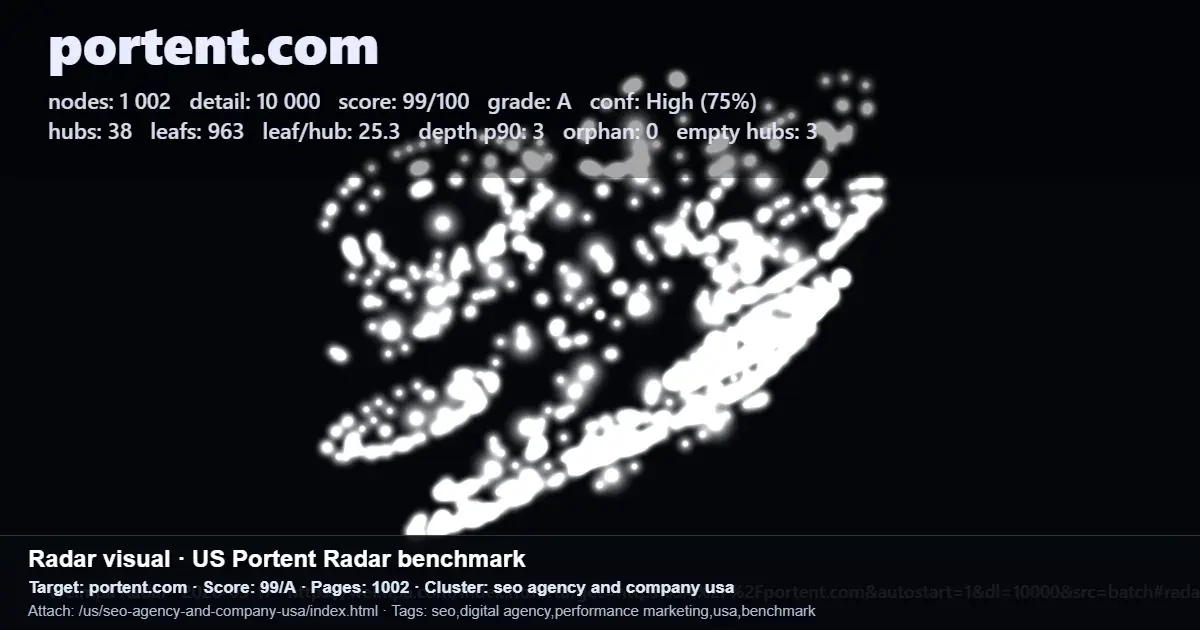
What this page covers
Programmatic SEO agency comparison
A useful programmatic SEO agency comparison should look past the vendor name. Start with the visible site structure: pages, hubs, leaf pages, crawl depth, orphan pages, and empty hubs.
US SEO agency benchmarks show a wide spread, from 29 pages with a 38/E score to 1,566 pages with a 100/A score. That makes structure a practical first filter.
In brief
- Compare agencies by the scale and organization of their SEO footprint, including pages, hubs, leaf pages, and depth.
- Look for structural risks such as empty hubs, orphan pages, or an uneven hub-to-leaf balance before assuming more pages means a stronger setup.
- Use Radar when you need a quick structural benchmark to support a choice between a self-serve pSEO tool and a managed build approach.
What to do
Start with architecture. Razorfish is benchmarked with 205 pages, 6 hubs, 198 leaf pages, a 33.0 leaf-to-hub ratio, depth p90 of 3, no orphan pages, and 2 empty hubs, with a 64/C score.
Then compare compact and large footprints side by side. Siege Media is benchmarked with 29 pages, 3 hubs, 25 leaf pages, an 8.3 leaf-to-hub ratio, depth p90 of 2, no orphan pages, and no empty hubs, with a 38/E score.
Use a stronger benchmark as a reference point, not as a universal rule. Conductor is benchmarked with 1,566 pages, 52 hubs, 1,513 leaf pages, a 29.1 leaf-to-hub ratio, and a 100/A score.
What to keep in mind
This comparison is most useful when your main concern is programmatic SEO structure: whether a partner can plan hubs and leaf pages clearly and keep a larger page set organized.
It is not a complete agency evaluation by itself. The available signals do not cover pricing, contracts, team quality, content workflows, timelines, or guaranteed business outcomes.
For buyers comparing a self-serve pSEO tool with a managed 1000&1 Pages build, Radar can help show whether structural gaps are significant enough to justify a managed pilot layer.