
Programmatic SEO planning
What this page covers
Programmatic SEO planning
Programmatic SEO planning starts with site structure: total pages, hubs, leaf pages, depth, and whether important sections are clearly connected.
Radar benchmarks show how US sites can have very different SEO structures, from small education examples to sites with about 10,000 pages.
In brief
- Use programmatic SEO planning to review page architecture before expansion, especially when hubs and leaf pages are part of the model.
- Compare structural signals such as page count, hub count, leaf count, leaf-to-hub ratio, depth, orphan pages, empty hubs, and score.
- Keep internal linking controlled with an approved link map, exact anchor matches, frequency limits, and no invented URL targets.
What to do
A practical plan starts with a clear inventory. One education benchmark shows 21 pages, 3 hubs, 17 leaf pages, depth p90 of 2, no orphan pages, no empty hubs, and a 27/E score.
Scale changes the planning problem. A TrueCar benchmark shows 10,003 pages, 2 hubs, 10,000 leaf pages, a leaf-to-hub ratio of 5,000.0, depth p90 of 4, and a 72/B score.
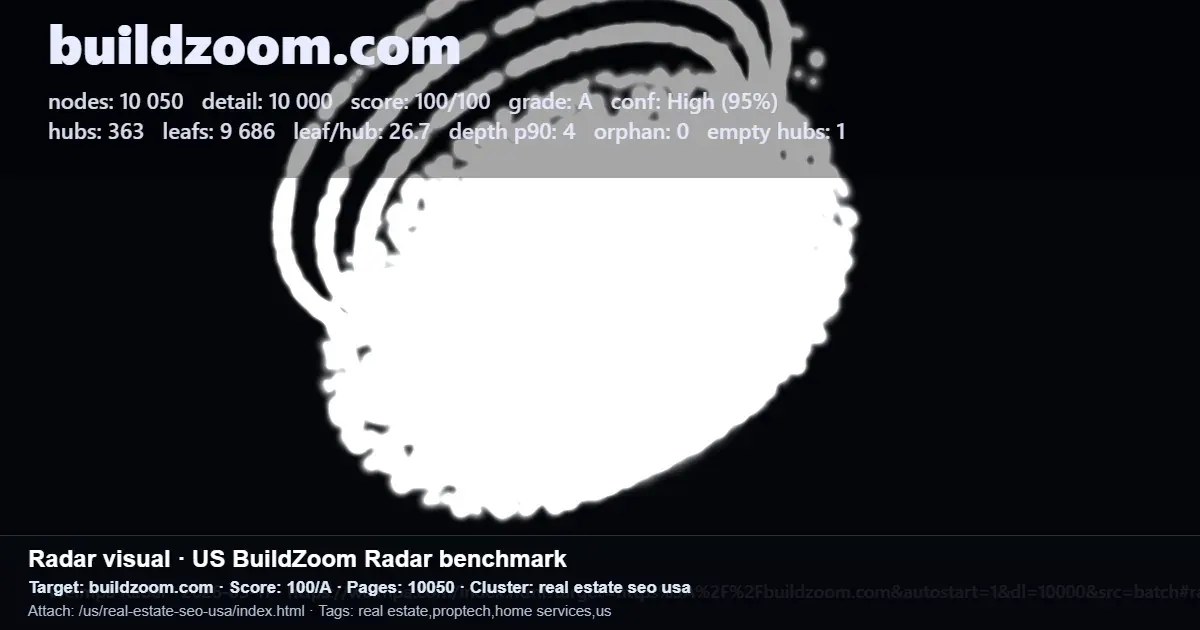
Another benchmark, for Children’s Hospital of Philadelphia, shows 10,096 pages, 388 hubs, 9,707 leaf pages, and a 100/A score. The contrast makes hub structure a useful planning signal, not just page volume.
What to keep in mind
This page is most useful when a site has enough repeated page types for hubs, leaf pages, depth, and internal links to matter. The benchmarks cover US education, logistics, auto, travel, healthcare, hospital, healthtech, medical, university, and edtech clusters.
The numbers show why page count should not be evaluated alone. A site with 10,003 pages scored 72/B, while another with 10,096 pages scored 100/A. A much smaller 21-page education benchmark scored 27/E.
Internal linking also needs constraints. The workflow reflected here uses an approved map, links exact matches, limits repeated links, prioritizes stronger context, and avoids creating URLs that are not already approved.