
SaaS SEO architecture
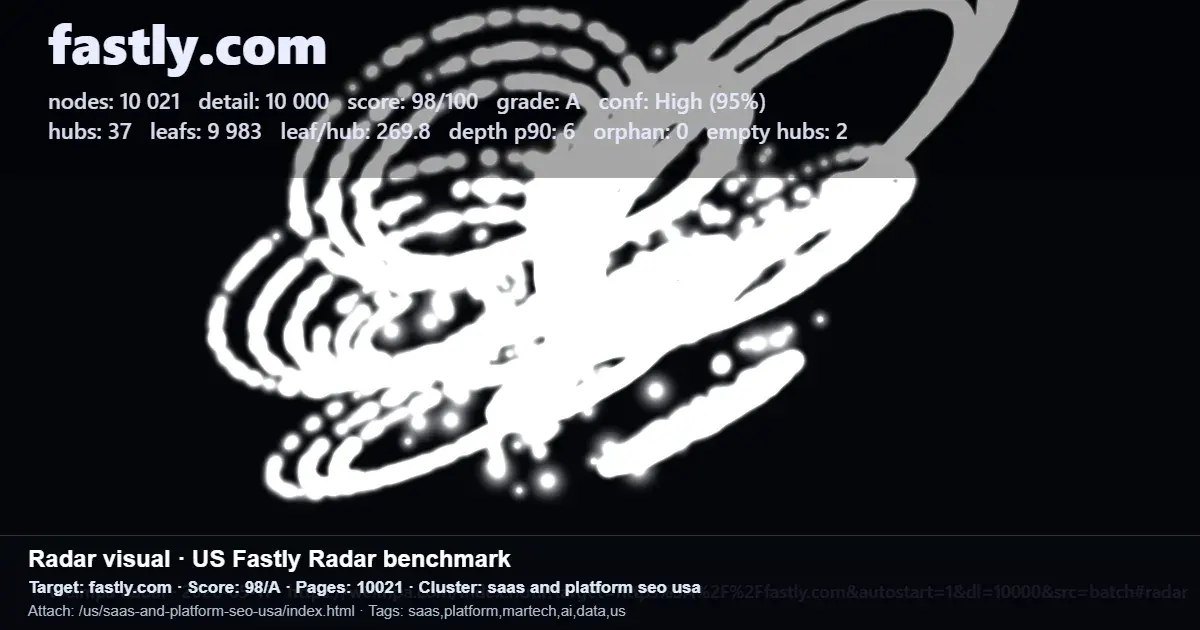
What this page covers
SaaS SEO architecture
SaaS SEO architecture is how a SaaS or platform website is organized into hubs, leaf pages, and measurable page groups that can be reviewed at scale.
Radar benchmark data for SaaS and platform sites shows this structure across properties ranging from a few hundred pages to more than 10,000 pages.
In brief
- A useful SaaS SEO architecture review starts with the page graph: total pages, hubs, leaf pages, and how those groups connect.
- Benchmarked SaaS and platform sites vary widely, from Heap with 765 pages and 24 hubs to Atlassian with 10,094 pages and 363 hubs.
- The goal is not to copy another site. It is to see whether your own architecture is visible, organized, and easy to review as a system.
What to do
For SaaS SEO architecture, a Radar-style review treats the site as a structured map, not a loose collection of URLs. The benchmark data shows page totals, hub counts, leaf counts, and scores for SaaS and platform sites such as Netlify, Heap, and Atlassian.
That makes the audit practical for larger SaaS properties. Netlify is shown with 3,718 pages, 168 hubs, and 3,549 leaf pages. Heap is shown with 765 pages, 24 hubs, and 740 leaf pages. These numbers create a concrete way to discuss architecture density and page grouping.
A good next step is to compare your own structure against the same signals: how many pages exist, how many act as hubs, how many are leaf pages, and whether the architecture is easy to inspect. That keeps the review grounded in observable site structure.
What to keep in mind
This page is most relevant if you manage or audit a SaaS, platform, martech, AI, or data site in the US market and need a clearer view of its SEO page architecture. The benchmark context is focused on SaaS and platform SEO in the US.
The examples show that strong site architectures can take different shapes. Asana is shown with 10,056 pages and 129 hubs, Atlassian with 10,094 pages and 363 hubs, and Netlify with fewer pages but a high benchmark score.
This does not define one universal ideal hub-to-leaf ratio, and it should not be treated as a ranking guarantee. It supports a careful architecture review based on visible page counts, hub counts, leaf counts, and benchmark context.