
Internal link mapping process for hub and leaf websites
What this page covers
Internal link mapping process for hub and leaf websites
Internal link mapping starts by making the site structure visible. Home, hub, and leaf pages should be reviewed as one connected URL map before links are changed.
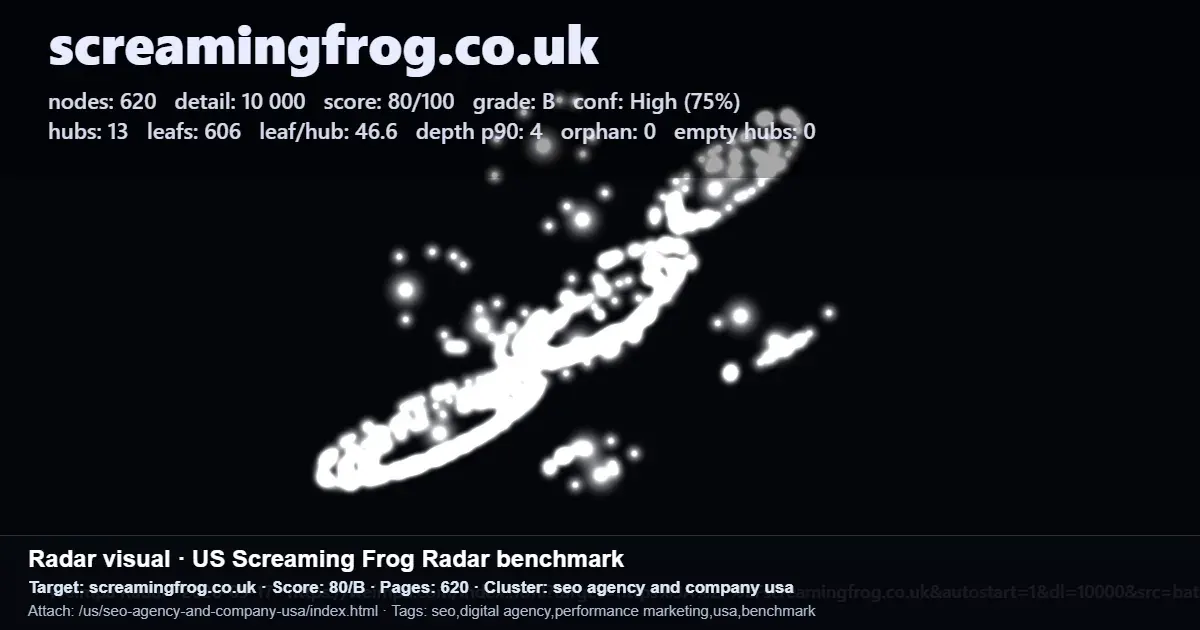
Radar helps validate that structure with a URL structure map, a shareable link, and a public scans feed. Demo runs are capped at 1,000 pages.
In brief
- Start with a home, hub, and leaf URL map so the relationship between major sections and detail pages is clear before editing links.
- Use the map to find hubs with too many leaf pages, hubs with too few supporting pages, and disconnected groups that need review.
- Keep the first pass practical. A Radar demo can map up to 1,000 pages per run and make the structure easy to share with stakeholders.
What to do
A useful internal link mapping process starts with URL structure, not anchor text. Group the site into home, hub, and leaf levels, then check whether important leaf pages have a clear path through relevant hubs.
Radar benchmark examples show why this matters at scale. One public benchmark for nih.gov lists 2,610 pages with 54 hubs and 2,555 leaf pages, while another for epa.gov lists 10,043 pages with 4 hubs and 9,999 leaf pages. Different hub-to-leaf patterns create different review priorities.
Once the structure is visible, use the map to decide where internal links need attention. Review hubs that should support important leaf pages, leaf groups that appear thinly connected, and sections where the structure does not match how the site should be understood.
What to keep in mind
This process is especially useful for websites where many pages depend on clear hub and leaf relationships. Large content inventories, metro sections, category pages, and listing-style structures are hard to review without a visible structure map.
It is not a full crawl, indexation report, or ranking guarantee. The Radar free demo is capped at 1,000 pages per run, so larger sites may need a scoped first pass or multiple reviews before decisions are made.
Benchmark data also shows that page count alone does not explain structure quality. A usa.gov benchmark lists 1,534 pages, 11 hubs, and 1,522 leaf pages with a 78/B score, while other benchmarks show different hub and leaf distributions. The mapping process should support diagnosis, not replace judgment.