
Real Estate Platform or Brokerage Marketing Lead
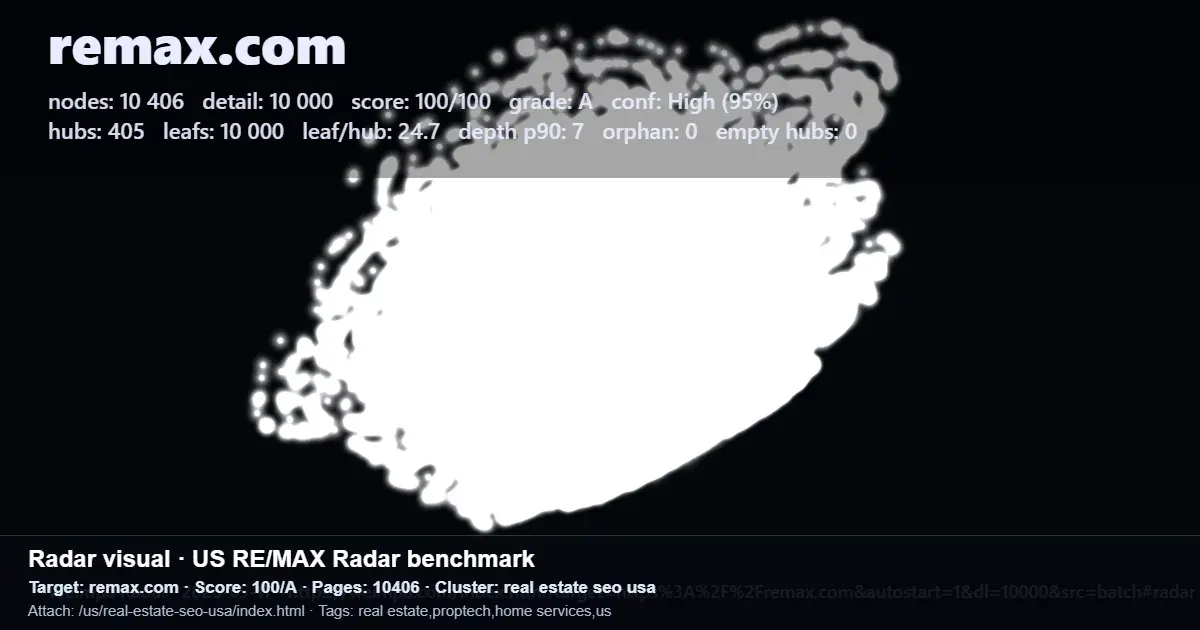
What this page covers
Real Estate Platform or Brokerage Marketing Lead
If you lead marketing for a real estate platform or brokerage, you may be managing city, neighborhood, service, office, agent, and audience-segment pages without creating thin or repetitive content.
A practical first step is to use Radar to benchmark comparable US real estate and property sites, then review where your hubs, leaf pages, and local coverage need a clearer structure.
In brief
- You may need a clearer view of how your site covers cities, neighborhoods, services, offices, agents, and buyer, seller, renter, or investor segments.
- Radar may fit if you need to compare page counts, hub and leaf structure, crawl depth, and score patterns before scaling SEO or AI-search content.
- Before expanding, check whether the issue is missing coverage, duplicate local pages, shallow content, crawl depth, or uneven quality across markets and offices.
What to do
For a real estate platform or brokerage marketing lead, the practical tension is scale versus quality. You may need coverage for metros, neighborhoods, rentals, luxury, new construction, investor searches, services, or agent support while keeping the site easy to understand.
Radar can support that work with benchmark and structure review. US real estate and adjacent property-site examples include extraspace.com with 10,014 pages and an 84/B score, angi.com with 10,008 pages and a 90/A score, and corcoran.com with 10,007 pages and a 75/B score.
A sensible start is not to publish more pages immediately. First compare your hub and leaf patterns with visible benchmark patterns, then decide whether to audit, consolidate, or expand city, neighborhood, office, service, and segment pages.
What to keep in mind
Radar benchmarks are useful for orientation, not as a promise of rankings, traffic, or lead volume. A score, page count, hub count, or leaf count can frame the discussion, but it does not prove that another site’s structure will work in your market.
This matters for brokerage networks, where content may be split across offices, regions, agents, and local templates. The safer use is to spot gaps, duplication risks, and shallow page patterns before changing templates or scaling new local pages.
The next step makes sense if you need a grounded view before asking teams to create more content. It gives marketing, SEO, and content stakeholders a shared starting point for deciding what to inspect, simplify, or expand.