
Healthcare search layer
What this page covers
This hub focuses on search in healthcare and how patients find services through Google and AI-powered interfaces. It is built for teams that work with web search data and want a clearer view of their organic demand.
You will find a structured way to think about search types, time ranges, and how different healthcare intents show up in web and AI results for specific queries.
Use this page as your starting point to see how a healthcare search layer connects your site, search engines, and AI-driven experiences, and where Radar can reveal gaps in that layer.
What to choose
- Explore how different search types, such as web search and AI answers, can be filtered and analyzed over a defined period like three months to see real demand patterns.
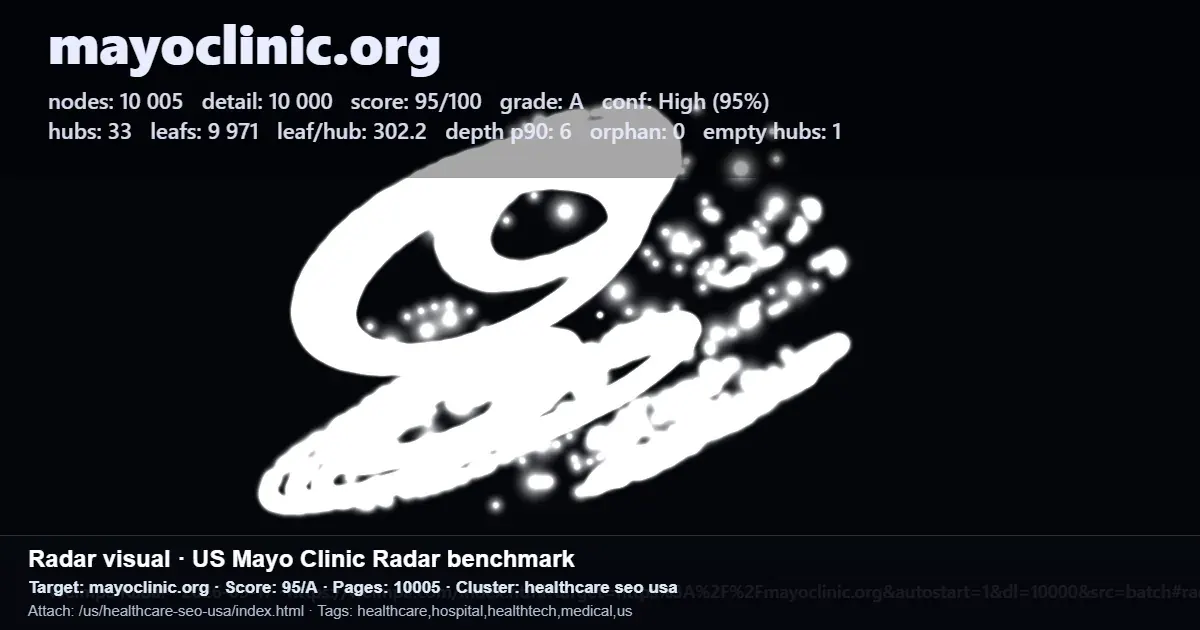
- Look at large healthcare sites in the US SEO space and how their hubs and leaf pages are distributed, then compare that structure to your own site with a Radar scan.
- Focus on healthcare-specific search questions across hospitals, healthtech, clinics, and medical topics, and see how they surface in web and AI search so you can plan a better search layer.
Where to go next
Below is a list of child pages that go deeper into specific aspects of the healthcare search layer, including how to work with organic traffic from Google and AI-powered results.
Use these pages to move from a high-level view of healthcare search to more detailed workflows, diagnostics, and examples you can apply to your own healthcare site.
What matters
- Search tools and AI surfaces commonly expose filters like time range, search type, and additional constraints, which help healthcare teams analyze how and where they appear in organic results.
- Benchmarks of large US healthcare, medical, and healthtech domains show complex hub-and-leaf structures with thousands of pages, where missing or weak hubs limit search visibility.
- Seeing how many pages, hubs, and leaf nodes a healthcare site has, and which ones are discoverable, can guide where to focus search, content, and structural improvements first. With Radar, this becomes measurable.