
Professional services seo page architecture
What this page covers
Professional services seo page architecture
Professional services sites in finance, legal, consulting, and insurance often manage thousands of pages. Their SEO performance depends on clear, scalable page architecture that helps search engines and users navigate complex offerings.
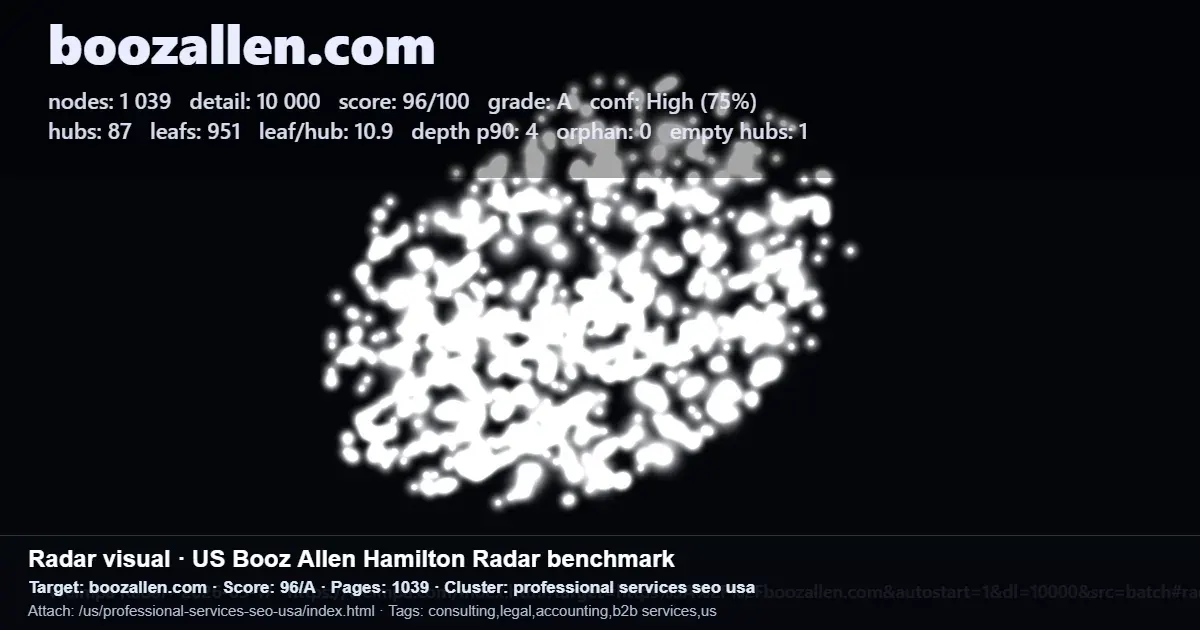
Radar benchmarks show that large US professional services domains can earn strong scores with well-structured hubs and leaf pages. This page explains how architecture choices support multi-location and multi-service SEO at that scale.
In brief
- Design hubs around core practices and audiences
- Group pages into clear hubs for banking, insurance, legal, or consulting services, then connect detailed leaf pages for products, industries, and locations. This mirrors how high-scoring domains like Truist and Perkins Coie organize thousands of URLs.
- Standardize multi-location and service templates
- Use consistent URL patterns, on-page modules, and internal links across all locations and offerings. This helps search engines understand scale, keeps navigation predictable, and supports growth from hundreds to thousands of pages.
What to do
High-performing professional services sites treat SEO architecture as a system of hubs and leaf pages that can scale to thousands of URLs without becoming chaotic. Benchmarks from large US domains in finance, insurance, and legal show that clear hubs for major practices or product lines, backed by deep leaf coverage, correlate with top Radar scores.
Start by defining hubs around your primary offerings and audiences, such as consumer banking, small business lending, commercial insurance, or specific legal practices. Each hub should act as a strong internal landing page that explains the category, highlights key value props, links to core sub-services, and routes users to the right location, segment, or industry. From there, attach leaf pages for individual products, industries, and offices so that every specific intent has a dedicated, crawlable destination.
As you expand, keep URL patterns and page templates consistent across locations and services. Large players like Truist, Lemonade, and Perkins Coie support thousands of pages by repeating a predictable structure, not by inventing new layouts for every offering. Use internal links from hubs to leafs and back again, and avoid orphaned or empty hubs that dilute crawl budget. This kind of disciplined architecture makes it easier for search engines to understand your footprint and for users to navigate complex professional services portfolios.
What to keep in mind
Architecture alone will not fix weak content or low brand demand. The professional services domains that score in the A range on Radar pair strong hub and leaf structures with substantial, differentiated content and clear positioning in finance, insurance, or legal services.
The hub-and-leaf model works best once you have enough depth to justify hubs. If you only offer a few services or operate in a single market, over-segmenting into many hubs can create thin or nearly empty sections that resemble the empty hubs seen in some large benchmarks and can confuse both users and crawlers.
Multi-location SEO architecture also has operational limits. Maintaining thousands of location and service combinations requires governance over templates, redirects, and navigation. Without consistent patterns like those visible on Truist, Lemonade, and Perkins Coie, the same scale that drives opportunity can quickly lead to duplication, crawl waste, and uneven performance across your portfolio.