
Real estate metro page seo structure
What this page covers
Real estate metro page seo structure
Real estate metro page SEO structure is about how your metro, city, and neighborhood pages are organized so search engines can understand and rank them inside a larger real estate site in the US market.
Radar benchmarks show that large real estate and proptech sites reach stronger SEO scores when their hubs and leaf pages are clearly structured, internally linked, and scaled across thousands of metro-focused pages.
In brief
- Metro page SEO structure defines how city and neighborhood hubs connect to thousands of listing leaf pages so search engines can crawl, group, and evaluate your real estate inventory at scale.
- Well-structured metro pages help avoid siloed listings by giving search engines clear location hubs, which can support stronger visibility for real estate, proptech, and home services sites in the US.
- With a tool like Radar, teams can benchmark their metro page structure against large US real estate SEO players and see how many hubs, leaves, and depth levels they are actually exposing to search.
What to do
A practical metro page SEO structure for real estate starts with clear hubs for major cities and metro areas, supported by neighborhood and segment pages, and then by individual listing leaf pages. Benchmarks from large US sites show that a small number of strong hubs can support many thousands of leaf pages when the hierarchy is consistent, shallow enough, and easy to crawl.
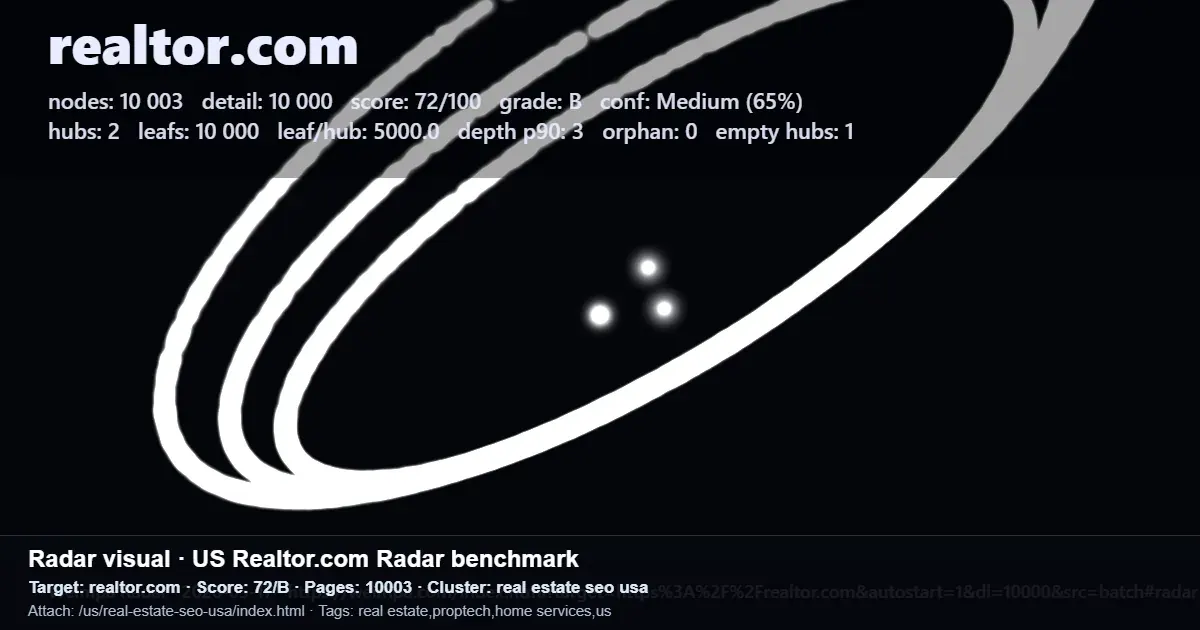
Radar visualizations of domains like Compass, RE/MAX, and BuildZoom highlight how many nodes, hubs, and leaves are in play, and how deeply they are nested. For example, a site may have around ten thousand pages, with hundreds of hubs and many thousands of leaf pages, all grouped into a coherent real estate SEO USA cluster for better discoverability.
By mapping your own metro pages into a similar hub and leaf model, you can see where location hubs are missing, where inventory is siloed, and how internal linking can be tightened. Radar benchmarks give a structured view of pages per hub, depth, and coverage so you can align your metro SEO structure with patterns used by high-scoring real estate and proptech sites.
What to keep in mind
Real estate marketplaces often find that property inventory pages are siloed and not well connected to city and neighborhood hubs, which weakens metro-level SEO. When metro hubs are thin or inconsistent, search engines may index many individual listings but fail to understand the underlying structure of locations and segments.
The same issue appears with segment and intent hubs for buyers and renters: they can be missing or weak, and internal linking between inventory, location hubs, and scenario pages can be inconsistent. This makes it hard to decide which inventory clusters should be highlighted for search and which metro pages should act as primary hubs.
As AI-powered search evolves, structured competitors with clearer inventory hierarchies and metro hubs may be favored. Using Radar to visualize how property inventory pages connect to cities and neighborhoods helps teams define segments, strengthen hubs, and reduce empty or redundant structures before scaling to tens of thousands of real estate SEO USA pages.