
Chief Marketing Officer in US Company
What this page covers
Chief Marketing Officer in US Company
If you are a Chief Marketing Officer at a US company, you may need a fast, clear view of how your website is positioned for Google search and AI-powered discovery.
A practical first step is to run a Radar benchmark, review the score, grade, page count, hubs, leaf pages, depth, and cluster fit, then decide what needs deeper team review.
In brief
- You may need a domain-level benchmark that turns website structure into signals your marketing, SEO, content, or agency teams can discuss.
- Radar may fit when you need an early read on site architecture, search coverage, and cluster position before assigning deeper SEO, GEO, or performance work.
- Before acting on the results, check whether the comparison cluster matches your market and treat the score as decision support, not a ranking or revenue forecast.
What to do
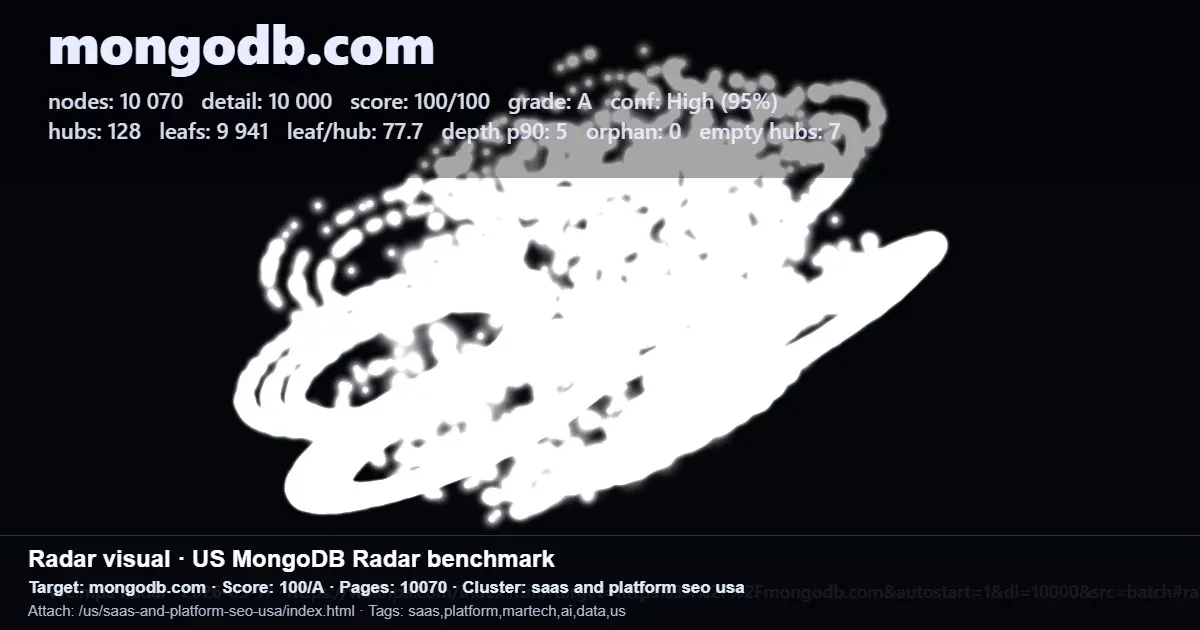
For a CMO, the pressure is often to decide where search and content work should focus first. Radar gives your team a shared view of domain-level signals such as score, grade, pages, hubs, leaf pages, depth, and benchmark cluster.
The most useful format is a focused benchmark of your company domain against relevant US market examples. It can help frame conversations about SEO, AI search visibility, agency evaluation, performance marketing, and broader inbound demand.
Start with the free Radar scan and review the output with your team. If the benchmark raises questions, use it to choose what to inspect next instead of treating one score as a complete strategy or forecast.
What to keep in mind
Radar benchmarks depend on the public domain data and the comparison cluster used. They can surface structural and competitive signals, but they do not guarantee rankings, AI visibility, lead quality, revenue, or campaign performance.
The comparison set may include sites with very different sizes and structures, from smaller page inventories to large domains with thousands of pages. The practical question is whether the cluster fits the decision you need to make.
This is a useful first step when you want a low-friction way to frame an SEO or AI search conversation. It gives your team a concrete benchmark before deeper analysis, planning, or execution begins.