
Programmatic SEO Agency Selection Criteria
What this page covers
Programmatic SEO Agency Selection Criteria
Choose a programmatic SEO agency by looking beyond the label. Useful criteria include page count, hub count, leaf pages, depth, empty hubs, and overall structural score.
A strong partner should explain how it will plan hubs and leaf pages as a repeatable system, not just deliver general SEO work or publish more pages.
In brief
- Compare agencies by measurable structure: total pages, hubs, leaf pages, leaf-to-hub ratio, depth, orphan pages, empty hubs, and score where available.
- Separate a general SEO agency from a programmatic SEO system by asking how repeatable page patterns, internal links, and governance will be planned and checked.
- For a US programmatic SEO agency search, prioritize partners that can explain the architecture they would build, not only the content volume they can produce.
What to do
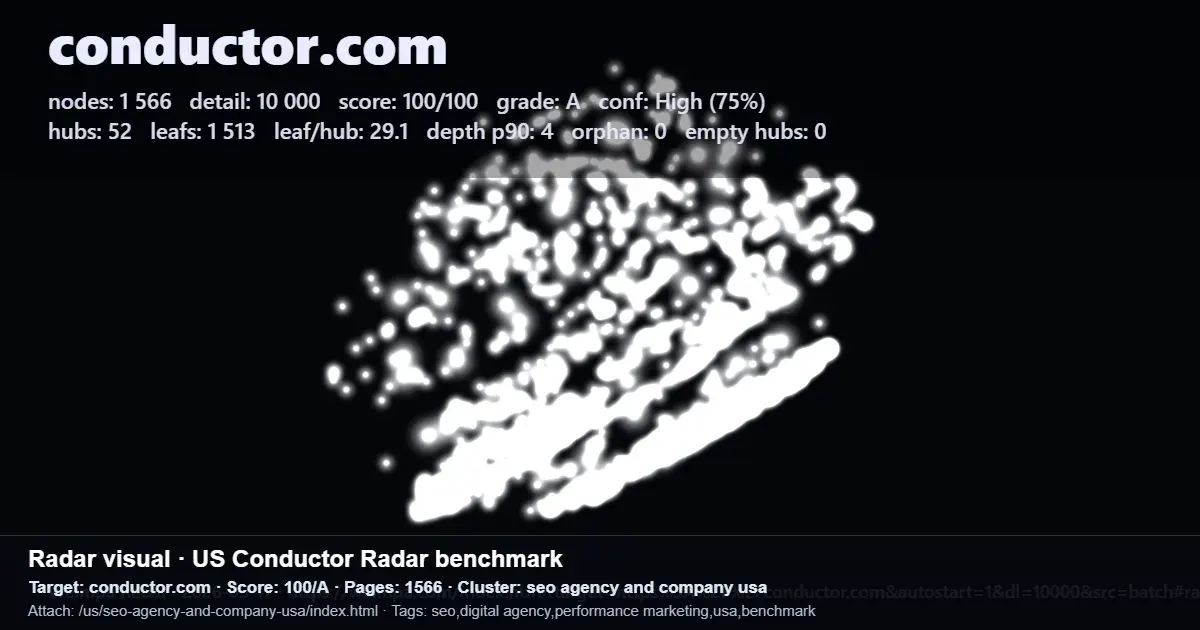
Start with measurable structure. In the US SEO agency and company benchmark set, Conductor is shown with 1,566 pages, 52 hubs, 1,513 leaf pages, a 29.1 leaf-to-hub ratio, and a 100/A score. These figures make page footprint, hub coverage, and leaf distribution practical criteria for evaluation.
Compare those signals with other structures before choosing a partner. Razorfish is shown with 205 pages, 6 hubs, 198 leaf pages, a 33.0 leaf-to-hub ratio, p90 depth of 3, and 2 empty hubs, with a 64/C score. Those metrics raise useful questions about depth, hub completeness, and navigation across page groups.
Also check whether the agency model fits your intended scale. Siege Media is shown with 29 pages, 3 hubs, 25 leaf pages, an 8.3 leaf-to-hub ratio, p90 depth of 2, and no orphan or empty hubs, with a 38/E score. A smaller structure may be easier to manage, but it still needs clear hubs, leaf pages, and quality controls.
What to keep in mind
The available comparison is strongest for site structure and benchmarking, not service promises. Use the criteria carefully: a high page count alone does not prove programmatic SEO quality, and a smaller page set does not automatically mean weak execution.
The agency selection conversation should cover both programmatic SEO fit and the difference between an agency retainer and a repeatable system. If a partner cannot explain how hubs, leaf pages, depth, and structural issues will be managed, the work may stay manual rather than become programmatic.
Benchmarks show visible differences across agencies and companies in pages, hubs, leaf pages, depth, empty hubs, and scores. Treat those differences as a due diligence prompt: ask what the agency will build, how it will measure structure, and how it will keep page groups coherent over time.