
Internal linking for hub and leaf pages
What this page covers
Internal linking for hub and leaf pages
Internal links between hub and leaf pages control how users and search engines move through your site. When hubs clearly connect to their related leaves, your structure is easier to understand and your content is easier to discover.
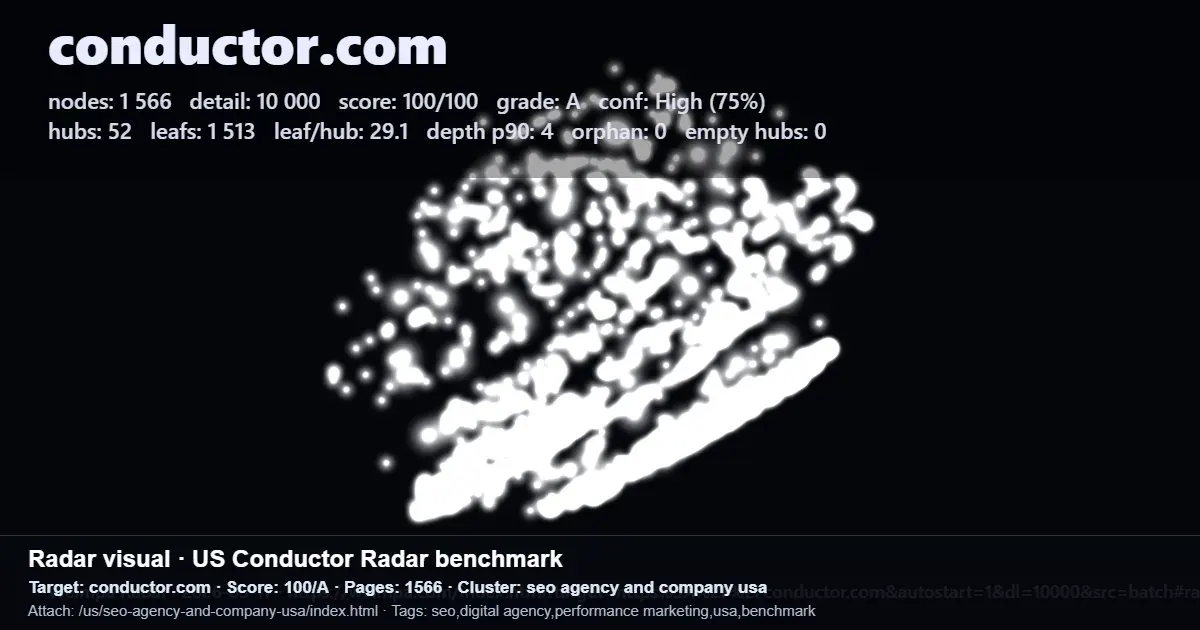
Radar score summarizes this structure quality by looking at coverage depth, hub‑to‑leaf distribution, and internal navigability signals. Strong hub–leaf linking supports a healthier site graph and clearer priorities across your pages.
In brief
- Group related leaf pages under clear hub pages that cover the broader topic. Each hub should link to all relevant leaves, and every leaf should link back to its hub so users and crawlers can see and move through the full cluster.
- Use internal links to show hierarchy and importance: home or pillar pages at the top, hubs in the middle, and detailed leaves at the bottom. This improves discovery, clarifies themes, and supports stronger rankings for both broad and specific queries.
- Monitor hub–leaf distribution and navigability with Radar score. If many leaves are orphaned or not grouped under hubs, add or refine hub pages and connect hubs and leaves until the graph is dense, consistent, and easy to traverse.
What to do
A healthy hub–leaf structure starts with a clear content map. Identify your broad topics and turn them into hub pages that introduce the theme and link to more specific leaves. For example, a hub on “Washing Machines” can link to leaves on each type, feature set, or use case. This mirrors the pyramid structure recommended in internal linking best practices, with home or pillar pages at the top, hubs in the middle, and detailed posts or product pages at the bottom.
Once hubs exist, make the connections explicit. From each hub, add contextual links to all relevant leaves in the body copy and navigation modules, not just in sidebars or footers. On every leaf, add a prominent link back to its hub and, where useful, to sibling leaves. This hub‑and‑spoke model helps search engines understand topical clusters, spreads authority from high‑value hubs to long‑tail leaves, and makes it easier for users to move between overview and detail.
Radar operationalizes this by building a URL graph and classifying pages as home, hub, or leaf. It then summarizes structure quality in a single Radar score that reflects coverage depth, hub‑to‑leaf distribution, and internal navigability signals. If diagnostics show that many leaf pages are not grouped under hubs, the fix is straightforward: introduce or adjust hub pages and link hubs and leaves until every important leaf sits inside a coherent cluster. Over time, this leads to a more crawlable, indexable, and strategically prioritized site.
What to keep in mind
Hub–leaf linking is not a magic switch for instant indexing or rankings. It works best when you already have useful, differentiated content and a crawlable technical setup. Competitors in programmatic SEO often emphasize internal linking and sitemaps as a way to quickly index large volumes of pages, but without real topical structure those links can become noise rather than clear signals.
Radar focuses on diagnosing the actual graph of your site instead of pushing you to publish more pages. It is most effective for teams that care about how pages relate: which URLs should be hubs, which are leaves, and where clusters are missing. If your strategy is only to publish tens of thousands of thin pages, tools that price by pages per month may look attractive, but they will not fix weak hub–leaf organization.
Radar is better suited when you want to tighten clusters, reduce orphaned leaves, and make internal links reflect real information architecture. Teams that use Radar to clean up hub–leaf relationships usually see clearer crawl paths, more consistent topic clusters, and a structure that is easier to maintain as the site grows.