
Radar scan workflow before a 1000&1 Pages pilot
What this page covers
Radar scan workflow before a 1000&1 Pages pilot
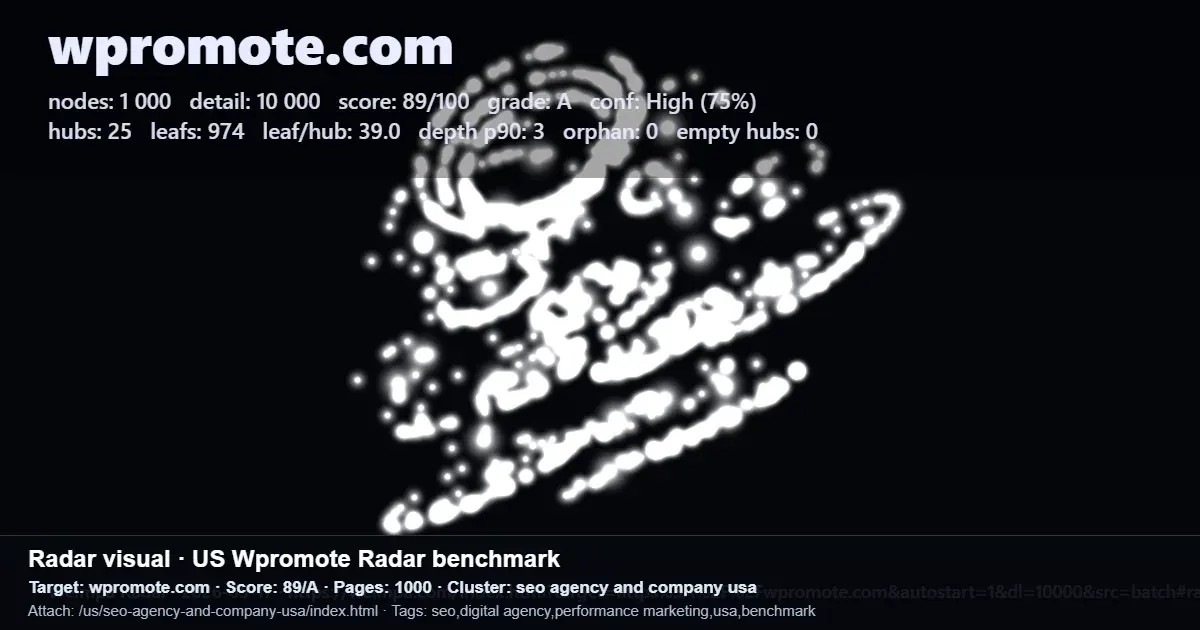
Before a 1000&1 Pages pilot, run a Radar scan to make the current structure visible: host, scan size, grade, page count, hubs, leaf pages, and leaf-to-hub pattern.
This keeps the pilot bounded. It helps the team diagnose the existing structure and weak entry points before choosing the first demand segments and page set.
In brief
- Start with a Radar scan so the team can review the host, scan size, grade, page count, hubs, leaf pages, and leaf-to-hub ratio before planning new pages.
- Use the scan to compare structural signals across large sites, including grades, hub counts, leaf counts, and page totals in the thousands.
- Keep the pilot narrow. Use the findings to choose the first demand segments, page architecture, and structural fixes before scaling a larger program.
What to do
A practical workflow starts by scanning the current site and reviewing the structural summary. Radar examples show outputs such as total nodes or pages, score and grade, hub count, leaf count, and leaf-per-hub ratio. These fields give the team a compact view of the site before adding a new search layer.
The next step is to decide whether the current structure is ready for expansion. A site with many leaf pages and very few hubs creates a different pilot risk than a site with hundreds of hubs and a more distributed leaf pattern. The goal is not to copy a benchmark, but to understand the starting shape.
The pilot brief should then stay tightly scoped. For a 1000&1 Pages program, the scan can support decisions about which hubs need attention, where weak entry points may exist, and how to define the first page set without turning the project into an open-ended SEO build.
What to keep in mind
Radar benchmark readings cover several US clusters, including real estate, professional services, and education. The examples include sites around 5,299 pages, 10,003 pages, and 10,394 pages, with different scores, grades, hub counts, and leaf counts.
Treat this workflow as a structural diagnostic, not a traffic promise. Its supported use is to inspect site structure, page scale, hubs, leaf pages, scan size, and grade before deciding how much of a 1000&1 Pages pilot to launch.
There is also a clear boundary for the public demo. It stores minimal telemetry to power the scans feed, including host, scan size, and grade. Radar pages on this site do not store raw crawl content.