
Hub/Leaf Internal Linking Rules
What this page covers
Hub/Leaf Internal Linking Rules
Hub/leaf internal linking rules define how broad topic hubs and supporting leaf pages should connect within a site architecture.
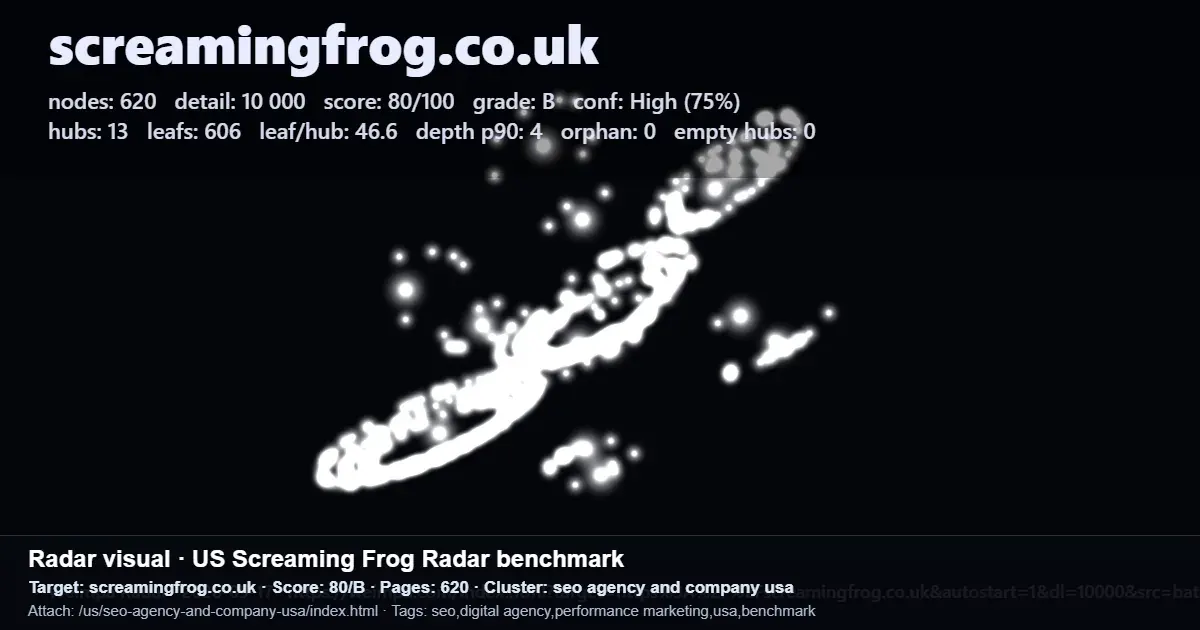
Radar benchmark data shows that hub and leaf patterns vary by site size, from 490 pages with 45 hubs to 6,127 pages with 37 hubs. The rules should reflect the real structure.
In brief
- Start by identifying which URLs act as broad topic hubs and which URLs act as supporting leaf pages for more specific topics.
- Use hub count, leaf count, and leaf-to-hub ratio as review signals, because benchmark examples show very different site structures.
- For larger architectures, internal linking automation becomes a relevant review area when manual inspection of every hub and leaf is impractical.
What to do
A hub/leaf rule set should start with classification. Decide which pages are hubs and which pages are leaves before judging individual links. This keeps the review focused on the structure of the cluster, not just isolated URL pairs.
Use measurable architecture signals to guide the review. Incubeta is listed with 490 pages, 45 hubs, 444 leaves, and a 9.9 leaf-to-hub ratio. Baker McKenzie is listed with 6,127 pages, 37 hubs, 6,089 leaves, and a 164.6 ratio.
These examples show why one fixed hub-to-leaf rule should not be applied to every site. A smaller site with many hubs needs a different review lens than a large site with thousands of leaf pages and a limited hub count.
What to keep in mind
The available benchmarks support structural inspection, not a universal formula. Dentons is listed with 5,052 pages, 12 hubs, 5,039 leaves, a 419.9 leaf-to-hub ratio, and a 79/B score.
A high or low leaf-to-hub ratio should be treated as a prompt for review, not as proof that the site is correct or broken. The practical question is whether the hubs and leaves match the intended topic structure.
This page is most useful when a site already has an internal linking strategy and needs clearer rules for hub and leaf relationships. If the issue is missing paths, review orphan growth pages or crawl depth next.